
Blue Chips vs Casino Chips
Two cards, the same price, completely different risk
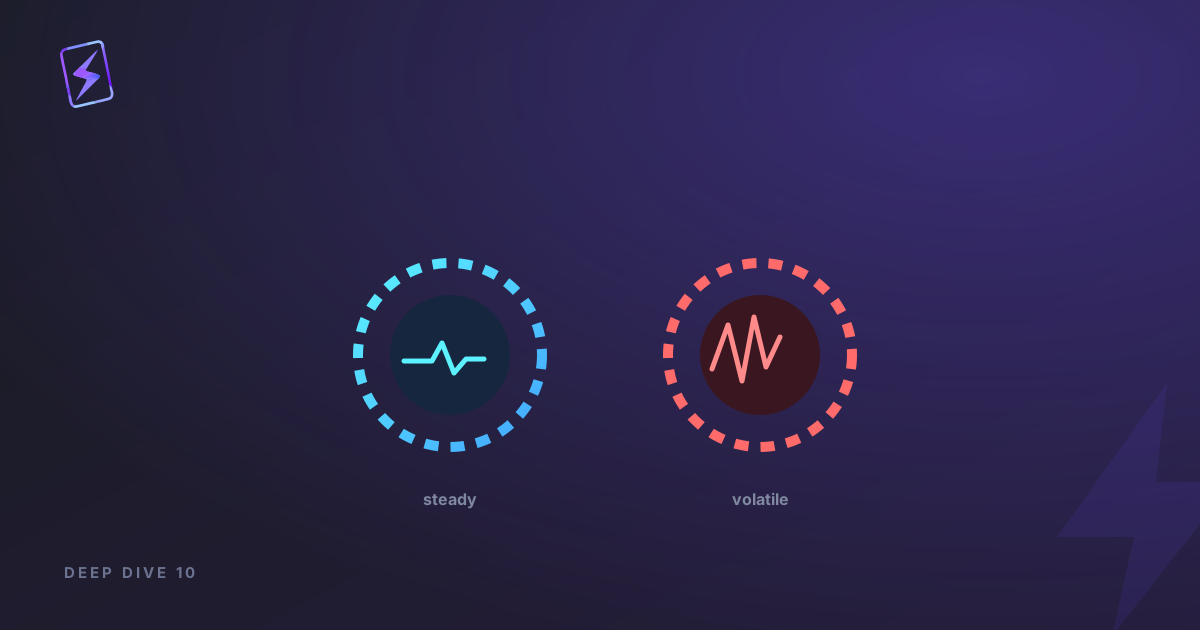
A price tells you what a card costs today. It says almost nothing about what it costs tomorrow. The number that protects you isn't the price. It's the swing.
Based on ~1,045,000 graded eBay sold comps (via Scrydex), pulled June 2026 and almost all from the past year. Treat it as a popular-card snapshot, not the whole market, so read these as directional findings.
A price is a cloud, not a point
Here is the single most useful idea I can give a flipper, and almost nobody talks about it: a card price is not a number. It's a distribution. When you see "$500" on a card, your brain stores a point. The market stores a cloud.
Pull the last thirty PSA 10 sales of almost any card and you won't get "$500" thirty times. You'll get $470, $530, $415, $560, $490, and so on: a spray of dots around a center. That center is the mean. The spread is the part that actually matters, and it's the part the headline price hides.
Across 3,530 liquid PSA 10 cards, the typical card swings about ±25% around its mean, and the average swing is even wider, around ±33%, because a long tail of chaotic cards drags it up. So a "$500 card" with a typical spread isn't a $500 card. It's a card that trades roughly $375 to $625, and which of those numbers you get depends mostly on luck and timing.
Once you see the cloud, you can't unsee it. "What's it worth?" stops being a question with one answer. The honest answer is a range, and the width of that range is the whole story.
Why the swing is the metric, not the price
Statisticians have a name for "spread relative to size": the coefficient of variation, the swing divided by the mean. It's how you compare the riskiness of a $200 card and a $5,000 card on the same scale. A 7% swing is a 7% swing whether the card is cheap or a grail.
This matters because of a trap your intuition sets for you. You assume expensive means safe. A $3,000 card feels like a blue-chip stock and a $40 card feels like a lottery ticket. Price has nothing to do with it. There are $3,000 cards that lurch 300% and $1,400 cards that barely move. High price is not low risk. High price is just high price.
The deeper point is that the last-sold price tells you nothing about your risk. It's one dot from the cloud, and it might be the high dot or the low dot. To know what you're holding you have to look at the shape of the comps: are they clustered tight, or sprayed across a canyon? The spray is the risk. The spray is the part you're actually buying.
The blue chips: tight clouds, deep liquidity
At the calm end of the distribution live the cards that earn the name store of value. The steadiest liquid PSA 10s swing only about ±7% around their mean, roughly a quarter of the typical card's wobble.
Two clean examples. Mega Charizard X ex (125/094) sits around $2,500 and has changed hands hundreds of times, with sales packed into a narrow band. Team Rocket's Mewtwo ex (231/182) does the same thing near $1,440. These are expensive cards that behave themselves.
Notice why they're steady, because it's not magic. It's deep liquidity. Hundreds of recent sales means hundreds of independent buyers and sellers all voting on the same number, and a crowd that big converges. One weird auction can't move the mean. A tight range plus real volume is the closest thing this hobby has to a savings account: you can reasonably predict what it'll fetch next month, and you can reasonably expect to actually sell it next month. Predictability and liquidity are the same virtue wearing two hats.
A blue chip doesn't promise you'll make money. It promises the number won't surprise you, and that you can get out. For capital you don't want to gamble, that's the whole point.
The casino chips: clouds that blow out 200–500%
At the other end, the cloud stops being a cloud and becomes a weather system. The widest cards in the set don't swing ±25%. Their ranges blow out 200% to 500%. Same price tag as a blue chip, on paper. Wildly different animal in your hands.
With a card like this, the "price" is almost meaningless. If recent sales run from $400 to $1,600, what is it worth? Whatever the next listing happens to do. Buying it at the displayed average is like buying a stock at its 52-week midpoint and calling that the price: you're as likely to be 50% underwater as 50% up before you've done anything.
These are bets, not holdings. Sometimes they're bets worth making. But you have to know you're making one, and the only way to know is to look at the cloud before you buy. A card with a 400% range is the market telling you, in plain language, that it does not agree with itself about what this thing costs.
What actually widens the cloud
So what makes one card's cloud tight and another's a canyon? Not randomness, but a few real forces, and knowing which one you're looking at changes what the range means.
Thin liquidity. A card that sells a few times a quarter has a noisy range by construction. With only a handful of comps, each from a different week and a different buyer, the spread is small-sample scatter as much as anything. Deep, liquid cards converge; thinly-traded ones look wider simply because the market hasn't voted often enough to settle.
A genuine trend. Some wide ranges are just a card that's moving, climbing or sliding across the 90-day window. That's direction, not chaos, and a date-aware look at the comps shows it instantly: a tilt, not a smear. A rising card's "range" is mostly yesterday's lower prices.
Real differences within the same grade. Two PSA 10s of the exact same card are not identical objects. Centering, print quality, eye appeal, a low cert number: the market pays up for the standouts and discounts the weak ones, all inside the same "10." That spread isn't noise or error. It's the market pricing genuine quality the label doesn't capture, so a wide range can simply mean the grade holds a real spectrum.
Compare like with like
The market already separates the prints that share a name. Shadowless, 1st Edition, and Unlimited Base Set Charizard (all 4/102) trade as three distinct cards at three distinct prices, and everyone in the hobby knows the difference. The discipline is simply making sure your read is scoped to the exact one you hold.
So when a range looks wild, the first move isn't to panic. It's to confirm you're looking at one print, one grade, one variant, and a recent window, then pull the comps for that card rather than a blur of everything that shares its number.
Pin the identity and a scary-looking spread often settles into the calm, real range of the specific thing you mean. The width you were staring at was partly a question about which card, and once that's answered it shrinks.
What's left after that is the honest spread, and now it means something concrete: thin liquidity, a live trend, or genuine within-grade quality. That's the number worth acting on, the one that actually describes the card in your hand.
The discipline: read the cloud, size like a bet
None of this is academic. It changes what you do on a Tuesday with a card in front of you.
Look at the cloud, not the point. Before you buy, pull the comps and look at the shape. Tight cluster, or canyon? The last sale is one dot; ignore it as a verdict and read the whole spray.
Treat the swing as a risk gauge, not the price. A tight range at a high price is a holding. A wide range at any price is a position. Price tells you the cost of entry; swing tells you what kind of thing you're holding once you're in.
Size wide-range cards like bets. If a card trades across a 300% range, don't put store-of-value money into it. Put bet-sized money in, and only if the upside justifies the spread. Concentrate your real capital in the tight, liquid, boring stuff.
And when a range looks insane, scope before you panic. Make sure the comps are one print, one grade, one variant, then read what's left. Often the "wild" range is thin volume or a live trend, not danger.
What the number can and can't tell you
A price is honest about exactly one thing: what it costs to get in right now. That's worth knowing. It just isn't worth what we ask it to be worth.
Everything you actually care about (is this safe, can I sell it, will the number surprise me) lives in the spread, not the price. The point is the headline. The cloud is the truth.
So build the habit of seeing two numbers where you used to see one: the price, and the swing. Cost, and risk. A card with the same price as another can be a vault or a roulette wheel. The only way to tell them apart is to stop reading the dot and start reading the cloud.
The takeaway: Price tells you the cost; price swing tells you the risk. The steadiest high-value PSA 10s swing only ~±7% on deep volume, the real stores of value. The widest blow out 200–500%, driven by thin liquidity, a live trend, or real within-grade quality, not by anyone confusing one card for another. Read the shape of the comps, not the last sale, and scope them to your exact print. Size tight-cloud cards like holdings and wide-cloud cards like bets.
The numbers
- Dataset: 3,530 liquid PSA 10 cards (sufficient recent sales to measure a distribution). "Swing" = the spread of recent comps around the mean (a coefficient-of-variation style measure). Figures are aggregates across that set unless a specific card is named.
- Typical vs average: the median card swings ~±25% around its mean; the average swing is ~±33%, pulled up by a long tail of chaotic/conflated cards. Both are aggregate measures, not promises about any single card.
- Tight-cloud examples (~±7%): Mega Charizard X ex (125/094, ~$2,500, hundreds of sales); Team Rocket's Mewtwo ex (231/182, ~$1,440). Prices are approximate recent means in USD.
- Wide-cloud example: "Charizard 4/102" spans Shadowless → 1st Edition → Unlimited Base Set under one name+number, a 200–500% range that is partly real value difference and partly data conflation across distinct prints.
- Caveat: a tight range is not a buy signal and a wide range is not a sell signal. Swing measures predictability and risk, not future return. Nothing here is financial advice; it's a way to read what the comps are already telling you. All figures USD.
- Source & date: figures are computed from Surge Cards' comp pool, about 1,045,000 graded eBay sold comps (sourced via Scrydex), pulled in June 2026. The pool is recency-weighted: ~87% of these sales are from 2026 and ~95% fall within the past year, so it reads as a current-market snapshot rather than a multi-year history. Per-figure sample sizes are listed above; figures using a recent window (e.g. last 90 days) are labelled as such.
Price any card on the real data
Surge Cards is the ledger built for serious Pokémon flippers — live comps, projected profit, ROI, and fees on every buy and sell.
Get started freeFigures are drawn from Surge Cards' own dataset of graded sold listings (via Scrydex), skewed toward popular cards and recent sales. Directional, not financial advice. All amounts USD unless noted.