
English vs Japanese
Two markets, one franchise, a price gap that isn't a currency trick
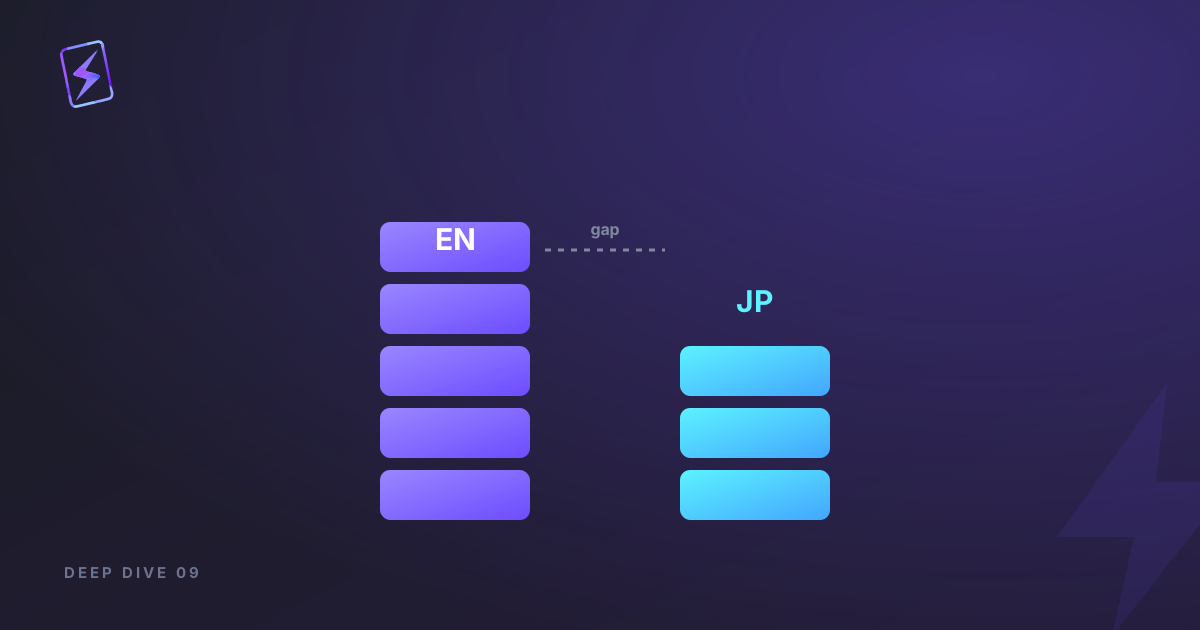
The same Charizard sells for nearly twice as much in English as in Japanese, yet the Japanese version trades a third of all volume. That isn't an exchange-rate illusion. It's two different psychologies, two different demand curves, meeting on the same cardboard. Here's what each market is actually buying.
Based on ~1,045,000 graded eBay sold comps (via Scrydex), pulled June 2026 and almost all from the past year. Treat it as a popular-card snapshot, not the whole market, so read these as directional findings.
The gap that won't close
Pull every PSA 10 sale across both languages and the numbers settle into a stubborn shape. English PSA 10 median: $150, across 227,462 graded sales. Japanese PSA 10 median: $82, across 153,407. That's roughly a 1.8× premium for English: not on one chase card, not in one set, but as a market-wide tendency that holds year after year.
Now the twist that breaks most people's intuition. The cheaper market is the busier one in relative terms. Japanese cards make up about a third of total graded volume, an enormous, liquid, deeply traded pool. So we have a good that is more abundant, more printed, more available, and yet the version that's scarcer to the buyer who wants it commands the higher price. Abundance didn't suppress the English number. Demand psychology lifted it.
All-grade medians tell the same story at a gentler slope: English ~$99 versus Japanese ~$60. The premium narrows when you stop filtering for perfection, which is itself a clue. More on that later. For now, sit with the headline: same Pikachu, same Charizard, same art in many cases, and a price spread that refuses to converge.
First, kill the currency illusion
Before we explain the gap, we have to disarm the trap that makes the gap look fake. Both of those figures are in US dollars. The Japanese $82 is not a yen price. It's a US-market sold comp (a Japanese card, graded, sold on a Western platform, settled in dollars) placed next to the English dollar price so the comparison is apples to apples.
This matters more here than on almost any other topic we cover. If you ever wander over to a Japanese-language marketplace, see a card listed at ¥12,000, and mentally file it as 'twelve thousand dollars,' you have just mispriced a card by a factor of about 150. The yen-to-dollar conversion is roughly 150:1, and that single slip, treating a foreign-denominated number as a domestic one, is the fastest way an excited flipper torches a bankroll on a 'steal' that was never cheap or never expensive in the first place.
So the rule for the rest of this piece, and frankly for your whole ledger: compare like-denominated comps, or compare nothing. A price gap is only real when both prices live in the same currency, on the same kind of platform, for the same grade. Ours do. Which means the 1.8× is a behavioral fact, not an FX artifact, and that's exactly what makes it interesting.
English is buying a childhood
Here's the cleanest way to understand the English premium: most English buyers in the West aren't buying a card. They're buying the exact object they remember. The Base Set Charizard (Base Set #4) a 35-year-old chases isn't a rectangle of value-bearing cardboard. It's the one that sat in a binder in 1999, the one a sibling traded away, the one that meant something on a playground. That's an identity purchase, and identity purchases don't price like commodities.
Behavioral economists call the broader force home bias, the well-documented tendency to overweight the familiar, the domestic, the thing that feels like ours. For a Western collector, the English print is home. It carries the typeface they read as a kid, the set symbol they recognize on sight, the language of the cartoon they watched. The Japanese version may be the literal original, but it isn't their original.
The economic consequence is a sentimental price floor. Sentiment doesn't chase yield. It doesn't dump when the market wobbles, because the buyer was never holding for return; they were holding because it's the one they remember. That stubbornness on the sell side is precisely what props the English median up and keeps it there. You're not bidding against speculators. You're bidding against people's memories, and memories rarely panic-sell.
Japanese is buying quality and the source
The Japanese market isn't 'the cheap version.' That framing is a Western blind spot. It's a different market, buying for different reasons, and two of those reasons are worth understanding precisely.
The first is quality. Among serious collectors, Japanese print runs carry a reputation for tighter centering, cleaner edges, and more consistent surface, which is exactly why purists hunt them and why the all-grade gap ($99 vs $60) compresses harder than the PSA 10 gap. When the population is full of near-perfect cards, gem-mint stops being a lottery and becomes the baseline; that abundance of quality drives volume up and pushes the median down, because you're no longer paying a scarcity tax to find a clean copy.
The second reason is the source. Sets debut in Japanese first. For the speculator, that early access is the entire appeal: a Japanese print is the leading edge of information, the place where a chase card's trajectory shows itself before the English release even ships. So Japanese demand skews toward quality-seekers and speculators rather than nostalgics. That blend produces the market's signature shape: high volume, lower median, faster turnover. It's a trading floor, not a memory lane.
Two demand curves on one good
Step back and the structure becomes elegant. This is one physical good, frequently the same artwork, supporting two separate demand curves that barely touch.
The English curve is driven by sentiment and identity: a buyer pool that's relatively price-insensitive because the purchase is emotional, with a floor held up by holders who won't sell at any reasonable number. Fewer transactions, higher prices, stickier holders.
The Japanese curve is driven by quality and speculation: a buyer pool that's far more price-sensitive and yield-aware, churning a deep, liquid population. More transactions, lower median, faster hands.
This is the textbook setup of two demand profiles on a near-identical product, and it explains the paradox we opened with. Price and volume diverge because they're measuring different things. Price is measuring how badly the marginal buyer wants this specific object, while volume is measuring how often the object changes hands. Sentiment maximizes the former. Speculation maximizes the latter. Same card. Two answers.
Why the arbitrage you're imagining doesn't work
The instant a flipper sees '$82 here, $150 there,' the same thought fires: buy Japanese, sell English, pocket the spread. It doesn't work, and understanding why is the whole skill.
You cannot turn a Japanese card into an English one. They are different goods that happen to look alike. The Western nostalgic who'll pay $150 specifically does not want the Japanese print, because wanting the exact remembered object is the entire reason they're paying the premium. Hand them the 'better' Japanese copy and you've handed them the wrong card. The spread isn't a mispricing waiting to be closed; it's the price of two different desires, and no amount of shipping cards across an ocean collapses it.
This is why cross-language arbitrage is hard in a way that cross-platform arbitrage isn't. Normally arbitrage closes because the goods are fungible. Here they aren't: the language is the product, because the language is what triggers the memory or signals the source. The gap is structural, not a glitch. Respect it as information, not as opportunity.
How a flipper actually uses this
The practical move is simple to say and disciplined to do: match the market to your buyer, and never treat the two as one.
Price against the right comp. If you're holding an English card for a Western nostalgia buyer, the Japanese sold comps are noise; they describe a different buyer entirely. Price off English-language, same-grade, dollar-denominated sales. Mixing the two pools into one 'Charizard' average will systematically misprice both directions.
Know which psychology you're selling to. Selling sentiment? Lean into the floor. These holders are patient, and so can you be; the English market rewards waiting. Selling into the Japanese pool? You're in a faster, deeper, more efficient market, so price to move, because volume is your friend and the median won't drift up to rescue an overpriced listing.
And keep your denominations clean. Every comp on your ledger should be USD-against-USD. The moment a yen number sneaks in unconverted, your entire read on the gap is off by 150×. That's not a rounding error; that's the difference between a thesis and a fantasy.
The honest caveat
Two markets, two psychologies, a 1.8× gap that's real and durable. But durable isn't permanent, and a median isn't a guarantee.
These are median figures across hundreds of thousands of sales; they describe the center of a distribution, not your specific card. A miscut English common won't ride the nostalgia floor, and a flawless Japanese chase card can blow past every median in either language. Grade, set, character, and condition all swamp the language effect on any individual card. The gap is a tendency, not a promise.
And tendencies move. Western interest in Japanese sealed and the speculative early-access trade have both grown; if Japanese cards keep accumulating their own Western nostalgia layer, the curves could drift toward each other over a decade. The structure we've described is the market as it trades today. Read it as a map of two psychologies, price each card against the buyer who actually wants it, and let the comps, in dollars, tell you the rest.
The takeaway: English and Japanese aren't two prices for one card; they're two cards that look alike, serving two different desires. English sells a childhood (identity, sentiment, a price floor held by people who won't sell). Japanese sells quality and the source: purist centering plus early-access speculation, deeper volume, lower median. The 1.8× gap is psychology, not currency, but only if you remember both numbers are in dollars. Price against the buyer you actually have, keep every comp USD-to-USD, and never arbitrage between two markets that were never the same market.
The numbers
- All figures are US-market sold comps in USD, both languages. The Japanese prices are not yen; they're dollars paid for Japanese cards on Western platforms, placed next to English dollar prices for a like-for-like comparison.
- PSA 10 median: English $150 (227,462 sales) vs Japanese $82 (153,407 sales), a ~1.8× English premium.
- All-grade median: English ~$99 vs Japanese ~$60, with the gap compressing once you stop filtering for gem-mint, consistent with Japanese cards' reputation for higher baseline quality.
- Yen↔dollar is roughly 150:1. A ¥12,000 listing is ~$80, not $12,000, and that's the single most expensive mental slip in cross-language pricing.
- Medians describe the center of a distribution, not any individual card; grade, set, character, and condition can swamp the language effect entirely.
- Cross-language 'arbitrage' generally fails because the cards aren't fungible; the language is part of the product.
- Source & date: figures are computed from Surge Cards' comp pool, about 1,045,000 graded eBay sold comps (sourced via Scrydex), pulled in June 2026. The pool is recency-weighted: ~87% of these sales are from 2026 and ~95% fall within the past year, so it reads as a current-market snapshot rather than a multi-year history. Per-figure sample sizes are listed above; figures using a recent window (e.g. last 90 days) are labelled as such.
Price any card on the real data
Surge Cards is the ledger built for serious Pokémon flippers — live comps, projected profit, ROI, and fees on every buy and sell.
Get started freeFigures are drawn from Surge Cards' own dataset of graded sold listings (via Scrydex), skewed toward popular cards and recent sales. Directional, not financial advice. All amounts USD unless noted.