
The Most Valuable Pokémon Isn't Charizard
By median PSA 10 value, the famous name isn't even top-three. Here's why the market pays for chase, not fame.
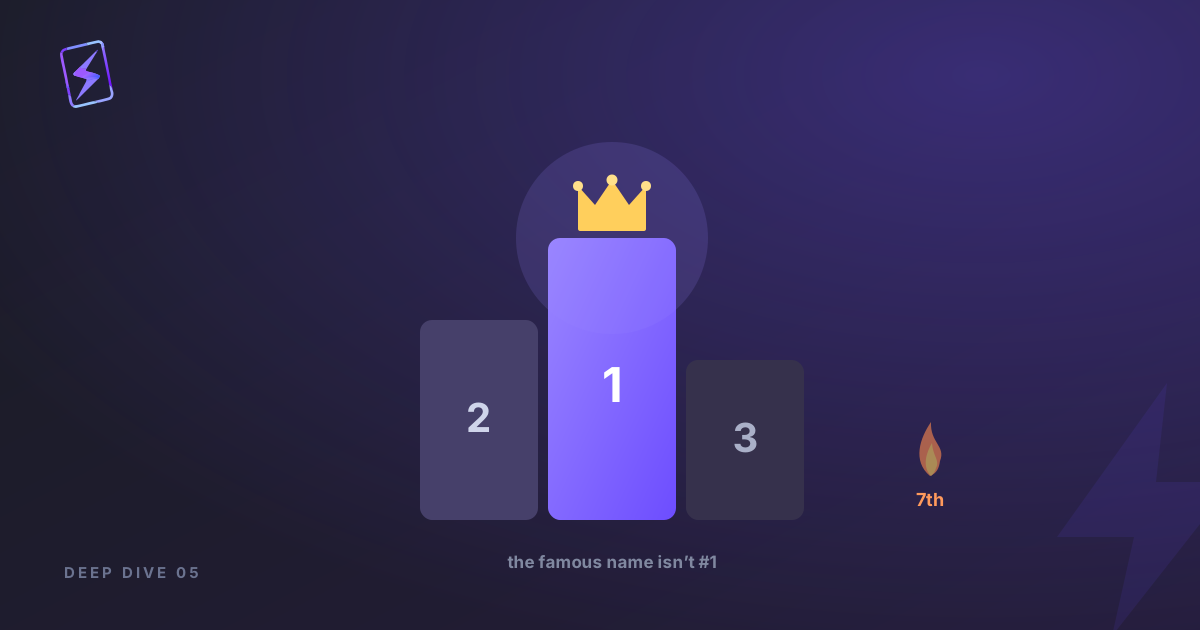
Charizard has a colossal ceiling and a mid-table typical card at the same time. That contradiction is the whole lesson. Ceiling and median measure two different things, and only one of them tells you what a card is usually worth.
Based on ~1,045,000 graded eBay sold comps (via Scrydex), pulled June 2026 and almost all from the past year. Treat it as a popular-card snapshot, not the whole market, so read these as directional findings.
The number that breaks the assumption
Ask anyone, collector or not, to name the most valuable Pokémon, and you get one answer. Charizard. It's the reflex. The orange dragon is the franchise's mascot of value, the card that headlines every auction story.
So here is the median PSA 10 value by species, in USD, computed across the cards we have graded comps for: Gengar $315 · Umbreon $277 · Pikachu $250 · Mew $225 · Rayquaza $224 · Mewtwo $210 · Charizard $205. Charizard is seventh.
Read that again. Not first. Not top-three. Below a ghost, below a moon-eyed fox, below the mascot rodent. The most famous name in the hobby has a thoroughly mid-table typical card.
This isn't a glitch in the data, and it isn't a knock on Charizard. It's a window into how value actually distributes, and into why the thing everyone knows about this market is true at the very top and false everywhere in the middle.
Median versus mean: the trick the average plays
First, the measurement, because it does all the work. There are two ways to summarise a pile of numbers, and they answer different questions.
The mean (average) asks: if you pooled all the value and split it evenly, how much each? One $325,000 sale in the pool drags the average up for everyone. The mean is exquisitely sensitive to the biggest number in the room.
The median asks: line every card up cheapest to dearest, then take the one in the exact middle. It doesn't care how extreme the top sale is. Add a million-dollar card and the middle barely moves. The median describes the typical case.
Pokémon prices are wildly right-skewed: a long, thin tail of grails stretching far to the right of a fat clump of ordinary cards. In any skewed pile, mean and median split apart, and the median is the honest one. It answers the question you actually have, "what is a card of this Pokémon usually worth?", instead of "what does the single best one go for?" Charizard's mean is colossal. Its median is $205. Both are real. They are not the same fact.
The Charizard paradox, stated plainly
Here is the paradox in one breath: Charizard has the highest ceiling and a mid-table median because it is printed on everything.
The ceiling is genuine and almost absurd. The biggest Charizard sale in our data is a 1st Edition Shadowless Base Set Charizard (4/102) in PSA 10 at $325,700, and the real record runs higher still: private and off-platform sales our eBay-based data never sees. Nothing else in the species table comes close. When people say "Charizard is the most valuable," this is the card in their head, and at the top they're right.
But ceiling is a single point. Median is the whole population. And Charizard's population is enormous. Twenty-five years of sets, reprints, special editions, promos, anniversary tins: the dragon shows up again and again, and most of those printings are cheap, abundant modern cards. Every one of them is a Charizard. Every one of them counts in the median.
So the species drags its own typical value down. Dozens of $15 modern Charizards sit in the middle of the line-up, and the one card standing at the median is one of them, not the grail at the far right end. Fame put Charizard on everything. Being on everything is exactly what hollows out the middle.
Why a ghost and a fox sit above the dragon
Now the contrast. Gengar's median PSA 10 is $315, the highest in the table, and Gengar has never had a record sale anywhere near Charizard's. How does the species with the lower ceiling carry the higher median?
Because Gengar appears on fewer cards, and a larger share of them are chase printings. The species isn't diluted by a long tail of cheap commons. Behind that $315 median sits real heat: a Gengar from Skyridge (H9, the holo, with its reverse-art H32 sibling) carries a PSA 10 median around $29,000. Gengar is a cult favourite, beloved, collected hard, printed sparingly, so its typical card stays premium.
Umbreon, $277, is the same story with a different fanbase. The Eeveelution crowd is fierce and the printings are leaner; the Umbreon 86/90 from HS Undaunted runs a PSA 10 median around $19,000. Fewer cards, more of them chased, so the middle of the distribution never gets watered down.
The pattern: scarcity of printings protects the median; abundance of printings poisons it. Charizard is a victim of its own ubiquity. Gengar and Umbreon are protected by their relative rarity.
Veblen, focal points, and the difference between fame and chase
Two ideas from economics make this click. The first is the positional, or Veblen, good, an object whose value rises because it's scarce and others can't easily have it. Demand goes up as price goes up, because the price is the point. Graded grails behave like this: the cost of ownership is the status. Reprint that card a hundred thousand times and you destroy the very scarcity that made it positional. Charizard's modern bulk is the anti-Veblen case: so available that owning one signals nothing.
The second is the focal point, Schelling's idea that, absent coordination, people converge on the obvious answer. Charizard is the franchise's focal point for value. It's the name everyone reaches for, which is precisely why it gets slapped on every product: the manufacturer is monetising the focal point. Fame, in other words, drives supply.
And that's the wedge between fame and chase. Fame is how many people know the name. Chase is how many people are competing for a specific printing. Charizard has maximum fame and, on most of its cards, ordinary chase. Gengar has modest fame and ferocious chase on the cards that matter. The market doesn't pay for recognition. It pays for the scramble.
What the medians can and can't tell you
Honesty about the data, because it shapes what you should conclude. Species are matched by name. When we say "Charizard," we mean every card whose identity resolves to that Pokémon, across sets, languages, and variants. That's the right unit for this question, but it means a species median blends Base Set with last year's tin.
The medians are biased toward popular and graded cards. We can only compute a median where graded comps exist, and people grade what they think is worth grading. So these figures over-represent the cards collectors already care about and under-represent the true bulk of cheap, ungraded cardboard. The real median across all printings would be lower for everyone, and the gap would be widest for Charizard, the most over-printed of the lot. The paradox isn't softened by the caveat. It's sharpened.
And medians describe the middle, not your card. Pikachu's $250 median spans an Illustrator-grade tail and a sea of promos. A species number is a starting hypothesis about a population, never a quote on the specific thing in your hand.
The lesson, and how to actually use it
Strip it down and the rule is short: the market pays for chase, not fame; ceiling is not typical; and "Charizard is valuable" is true at the top and false in the middle. The famous name sets the ceiling. Scarcity sets the median. Those are different forces, and conflating them is how people overpay for a bulk dragon and overlook a chase ghost.
To put it to work, run two checks before you trust a name. First: is this a chase printing or a bulk one? A vintage holo from a thin, beloved set behaves nothing like a modern reprint of the same Pokémon, even though both share the species. The species tells you almost nothing here; the printing tells you almost everything.
Second: pull the specific card's comps. Set, number, grade, and recent graded sales give you the actual middle of that card's distribution, not the species average. The species median is a prior, useful for spotting that something's off ("why is this 'Charizard' $9?"). The card's own comps are the answer.
Do both, and the dragon stops fooling you. You stop buying the name and start buying the scarcity, which, as the table quietly insists, is the thing that was valuable all along.
The takeaway: Charizard pairs a colossal ceiling with a seventh-place median, and both are true. Fame got it printed on everything, and being on everything is what hollows out the typical card. Cult favourites with fewer, chase-heavy printings, such as Gengar and Umbreon, keep premium medians. So judge a card in two steps: is this a chase printing or a bulk one, then what do the specific card's comps say. The market pays for the scramble, not the name.
The numbers
- Median PSA 10 value by species, USD, computed from graded comps where available: Gengar $315 · Umbreon $277 · Pikachu $250 · Mew $225 · Rayquaza $224 · Mewtwo $210 · Charizard $205 · Espeon $180 · Snorlax $164 · Blastoise $160 · Lugia $150 · Eevee $129.
- Median = the middle card when every graded sale is lined up cheapest to dearest; it ignores how extreme the top sale is. Mean (average) is pulled upward by a single record sale. Pokémon prices are heavily right-skewed, so the median is the honest measure of a typical card.
- Grails behind the medians (PSA 10 medians): Gengar H9/H32 (Skyridge) ~$29,000; Umbreon 86/90 (HS Undaunted) ~$19,000.
- Charizard record: $325,700 for a 1st Edition Shadowless Base Set Charizard (4/102) in PSA 10.
- Caveat: species are matched by name, so a species median blends every printing across sets and languages. Medians are biased toward popular, graded cards, so the true all-printings median would be lower for every species, and lowest for the most over-printed ones. A species figure is a prior, never a quote on a specific card.
- Source & date: figures are computed from Surge Cards' comp pool, about 1,045,000 graded eBay sold comps (sourced via Scrydex), pulled in June 2026. The pool is recency-weighted: ~87% of these sales are from 2026 and ~95% fall within the past year, so it reads as a current-market snapshot rather than a multi-year history. Per-figure sample sizes are listed above; figures using a recent window (e.g. last 90 days) are labelled as such.
Price any card on the real data
Surge Cards is the ledger built for serious Pokémon flippers — live comps, projected profit, ROI, and fees on every buy and sell.
Get started freeFigures are drawn from Surge Cards' own dataset of graded sold listings (via Scrydex), skewed toward popular cards and recent sales. Directional, not financial advice. All amounts USD unless noted.