
Not All 10s Are Created Equal
A "10" is a question (whose 10?), not a fact, and the gap between answers is roughly 3×.
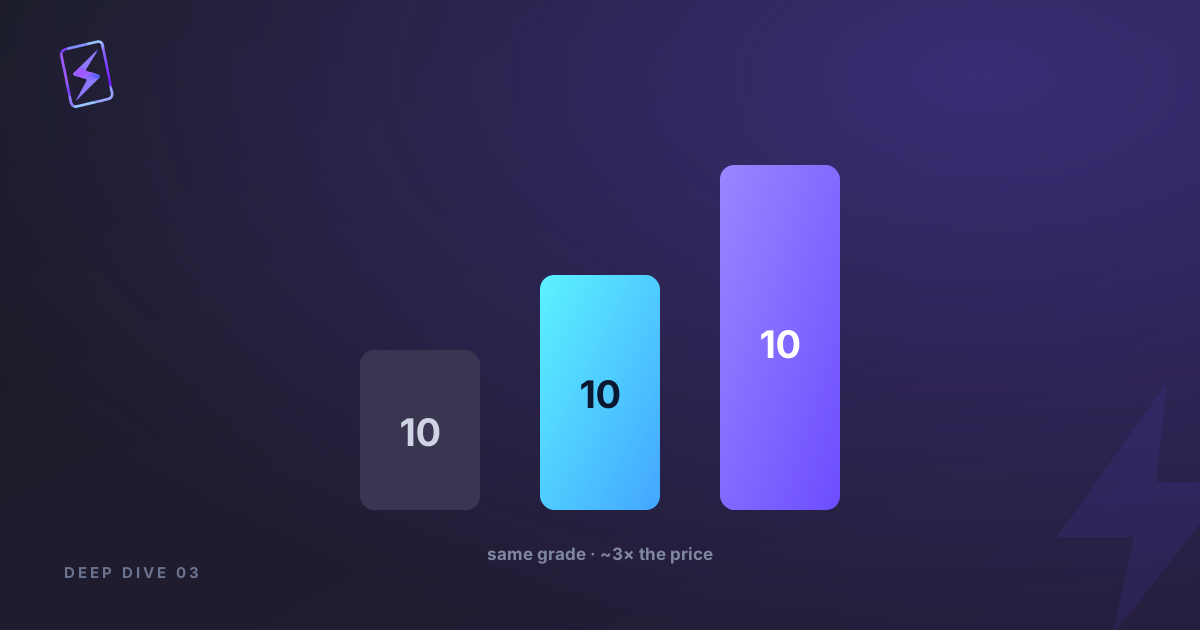
Two slabs both read "10" on the front. One is worth three times the other. The number isn't lying; it just isn't telling you which ladder it tops.
Based on ~1,045,000 graded eBay sold comps (via Scrydex), pulled June 2026 and almost all from the past year. Treat it as a popular-card snapshot, not the whole market, so read these as directional findings.
The number that isn't a number
A grade is supposed to collapse uncertainty. You hand a card to a third party, they apply a published standard, and you walk away with a label that means the same thing to every buyer on earth. That's the whole pitch: a graded slab converts a subjective claim into a standardized, verifiable, fungible asset. You're no longer buying a stranger's opinion. You're buying a grade.
Except "10" only does that job inside one grader. The instant you compare a 10 from one company to a 10 from another, the standardization quietly breaks. The scales don't line up; the top of one ladder is the second rung of another. The market prices that difference relentlessly, even when the digit on the slab doesn't.
So the honest version of the question isn't "is it a 10?" It's "whose 10, and is it that grader's best, or its second-best dressed up in the same digit?"
Three ladders, three different tops
Start with what each "10" actually sits on top of, because the labels hide it.
PSA stops at 10. Gem Mint 10 is the ceiling. There is no tier above it, no Pristine, nothing. When PSA says 10, it means "the best grade we issue." The pool is enormous: 380,664 Pokémon cards graded PSA 10, and effectively zero in any higher tier, because no higher tier exists.
CGC splits the top. It issues a Gem Mint 10 and, above it, a stricter Pristine 10, reserved for cards that are essentially flawless under magnification. CGC's grade-10 population is 70,200 Gem Mint plus 37,713 Pristine. So a "CGC 10" is ambiguous on its face: it could be the everyday top grade, or the rarer one above it.
BGS tops out differently again. Its 10 comes with four subgrades, and only when all four (centering, corners, edges, surface) are themselves 10 do you get the Black Label: the rarest standard "10" in the hobby. A plain BGS 10 with mixed subgrades is a different animal from a Black Label, even though both stamp "10."
Best vs second-best: the tier the digit hides
Line a PSA 10 up against a CGC 10 and the shared digit makes them look like the same rung. Structurally they often aren't, and the label is what flattens it: one number stamped on two different altitudes.
PSA's 10 is PSA's best. CGC's everyday 10, Gem Mint, is its second-best, because Pristine sits above it. So a PSA-10-vs-CGC-10 matchup isn't best against best. It's one grader's ceiling against another's penultimate rung. Same digit, different altitude.
The data is blunt about what that tier gap is worth. Across 3,760 matched pairs of the same card, a PSA Gem Mint 10 trades at 2.48x the price of a CGC Gem Mint 10. Two-and-a-half times, for the same card, both reading "10." It's tempting to chalk the whole 2.48x up to a "PSA premium," but part of it isn't brand at all. It's the tier mismatch: a top grade measured against a second-tier one. To isolate the real brand premium, you climb CGC's ladder to its actual top.
Climb to the real top, and the gap shrinks but won't close
Match PSA's best against CGC's best. PSA Gem Mint 10 versus CGC Pristine 10, the stricter grade, the one that's equal-or-tougher than what PSA issues. Now the spread collapses from 2.48× to 1.25× across 2,279 pairs. Most of that original gap was apples-to-oranges, exactly as the ladder argument predicts.
But it does not close. Even against a card that has cleared a stricter bar, PSA still commands about 25% more. Read that slowly: the CGC Pristine card is, if anything, the higher-quality object. The plastic is harder to earn. And the market pays a quarter more for the PSA anyway.
That residual 25% is the genuinely interesting number in this whole piece, because it can't be explained by condition. The condition argument has been controlled away. What's left is something economists have names for, and it's worth sitting with.
Why the better card loses: liquidity, network effects, and a Schelling point
The 25% PSA premium at equal-or-stricter quality is a liquidity premium plus a network effect plus a focal point, stacked.
Liquidity premium. PSA's pool is 380,664 deep on these cards; CGC Pristine is 37,713. A deeper pool means more active buyers, tighter spreads, faster sales, and a price you can actually trust because it's printed thousands of times a week. Assets that are easy to sell are worth more than identical assets that are hard to sell. You pay up for the exit, not just the card.
Network effect / Schelling point. When everyone expects everyone else to anchor on PSA, PSA becomes the default, the focal point a coordination game settles on without anyone agreeing to it out loud. Buyers want the slab the next buyer will want. Sellers list the slab buyers search for. Registries, price guides, and sold-comp tooling all index PSA first. The standard becomes self-reinforcing: it's valuable because it's standard, and it's standard because it's valuable. A stricter competitor grade can be objectively better and still lose, because being right is not the same as being the thing everyone coordinates on.
Brand moat. Layered on top is plain trust capital: decades of perceived consistency. Standardization is the product graders sell, and the brand people believe is the most consistent extracts rent for that belief. Some of the 25% is deserved. Some of it is just being the verb.
The twist: at the very top, scarcity beats the brand
If the story stopped there, it'd be "PSA wins, always, network effects are destiny." They're not. There's a ceiling where the logic flips.
Compare PSA 10 to a plain BGS 10 and PSA actually loses: the ratio is 0.68×, meaning the BGS 10 is worth more, though with only 141 matched pairs, treat that as a lean, not a law. Push to the top and it's emphatic. PSA 10 versus BGS Black Label comes in at 0.31×, so the Black Label is worth roughly 3× a PSA 10 (74 pairs, also thin, so caveat it honestly).
Why does the network effect break here? Because Black Label isn't competing on liquidity. It's competing on scarcity. A perfect-four-subgrade 10 is genuinely, verifiably rarer than a PSA 10, and the buyers at that altitude aren't optimizing for a fast exit. They're trophy buyers paying for the rarest provable version of the object. At the very top, true scarcity is a stronger force than brand convenience. The Schelling point governs the liquid middle; it does not govern the apex.
What the clean hierarchy actually looks like
Strip the shared "10" off all of these and rank them by what the market pays for the same card, and a clean ladder appears, one the label deliberately obscures:
Bottom: CGC Gem Mint 10. A real top-tier grade, but it's CGC's second-best and sits in a smaller pool. The value floor of the "10" club.
Middle: CGC Pristine 10. Stricter, scarcer, arguably the highest-quality object on this list pound-for-pound, and still priced below PSA on brand alone.
Upper-middle: PSA Gem Mint 10. Not the strictest grade and not the rarest, but the most liquid and the most trusted. The market's default winner everywhere except the apex.
Top: BGS Black Label 10. Where scarcity overpowers the network effect. Roughly 3× a PSA 10, on thin data, but directionally clear.
Same digit on the front of all four. A spread of about 3× from bottom to top. The number told you almost nothing; the brand and the tier told you everything.
What it means when you're holding the slab
The practical lesson is small and unglamorous: the "10" on the label is the least informative thing about the card. What moves the price is which grader, and which tier within that grader, and the label flattens both into one digit.
So read past it. A "CGC 10" in a listing is a question: Gem Mint or Pristine? Those are different assets at different prices. A "BGS 10" is a question: plain 10 or Black Label? That's a 3-to-1 question. Treating any of these as interchangeable with a PSA 10 because they share the number is how you overpay for the bottom of the ladder or underpay for the top of it.
And hold both truths at once. In the liquid middle, brand and liquidity win: the better card can be the cheaper card, and that's not irrational, it's the price of an easy exit. At the apex, scarcity wins, and the rarest provable grade outruns the most popular one. The market isn't confused about any of this. It's pricing condition, liquidity, coordination, and scarcity all at once, and then printing the result as a single, deceptively simple "10."
The takeaway: A "10" tells you the grader's verdict but not whose ladder it tops, and the same card, all reading 10, spans roughly 3× depending on the brand behind the digit and the tier beneath it.
The numbers
- PSA grade-10 Pokémon pool: 380,664 Gem Mint; 0 Pristine (PSA issues no tier above 10).
- CGC grade-10 pool: 70,200 Gem Mint + 37,713 Pristine (Pristine is the stricter, higher tier).
- Same card, PSA Gem Mint 10 vs CGC Gem Mint 10: 2.48× (3,760 matched pairs). But this compares PSA's best to CGC's second-best.
- Same card, PSA Gem Mint 10 vs CGC Pristine 10 (equal-or-stricter): 1.25× (2,279 pairs). The residual ~25% is brand + liquidity, not condition.
- Same card, PSA 10 vs BGS 10: 0.68×, BGS worth more (141 pairs, thin, directional only).
- Same card, PSA 10 vs BGS Black Label 10: 0.31×, Black Label ≈ 3× a PSA 10 (74 pairs, thin, directional only).
- Source & date: figures are computed from Surge Cards' comp pool, about 1,045,000 graded eBay sold comps (sourced via Scrydex), pulled in June 2026. The pool is recency-weighted: ~87% of these sales are from 2026 and ~95% fall within the past year, so it reads as a current-market snapshot rather than a multi-year history. Per-figure sample sizes are listed above; figures using a recent window (e.g. last 90 days) are labelled as such.
Price any card on the real data
Surge Cards is the ledger built for serious Pokémon flippers — live comps, projected profit, ROI, and fees on every buy and sell.
Get started freeFigures are drawn from Surge Cards' own dataset of graded sold listings (via Scrydex), skewed toward popular cards and recent sales. Directional, not financial advice. All amounts USD unless noted.