
The PSA 10 Premium
Why a tenth of a point can quadruple a price, and how to think about it like a trader.
A PSA 10 isn't a better card. It's a resolved argument. Once you see grading as the business of selling certainty, the premium stops looking crazy and starts looking like a pricing problem you can actually solve.
Based on ~1,045,000 graded eBay sold comps (via Scrydex), pulled June 2026 and almost all from the past year. Treat it as a popular-card snapshot, not the whole market, so read these as directional findings.
You are not paying for the card. You are paying for the end of the argument.
Before third-party grading, every used-card sale was a negotiation over reality. "Mint" meant whatever the seller needed it to mean, and the buyer had to trust a stranger's eyes across a blurry photo. That gap, never quite knowing what you're getting, is the friction that quietly kills markets. Economists call it the market for lemons: when buyers can't tell good from bad, they assume the worst and bid low, which drives the genuinely good stuff out of the market entirely.
A graded slab is a machine built to destroy that uncertainty. A neutral third party inspects the card, assigns a number on a 1–10 scale, seals it in tamper-evident plastic, and logs it in a public database. The card didn't change. The information about the card changed. And in any market priced on trust, information is the expensive part.
This reframes the entire premium. When you pay up for a PSA 10, you are not buying superior cardboard. You are buying the elimination of doubt, the right to never again argue with a buyer about whether the corners are soft. Certainty is the product. The card is just the thing the certainty is attached to.
The 9-to-10 cliff: a multiple, not a percentage
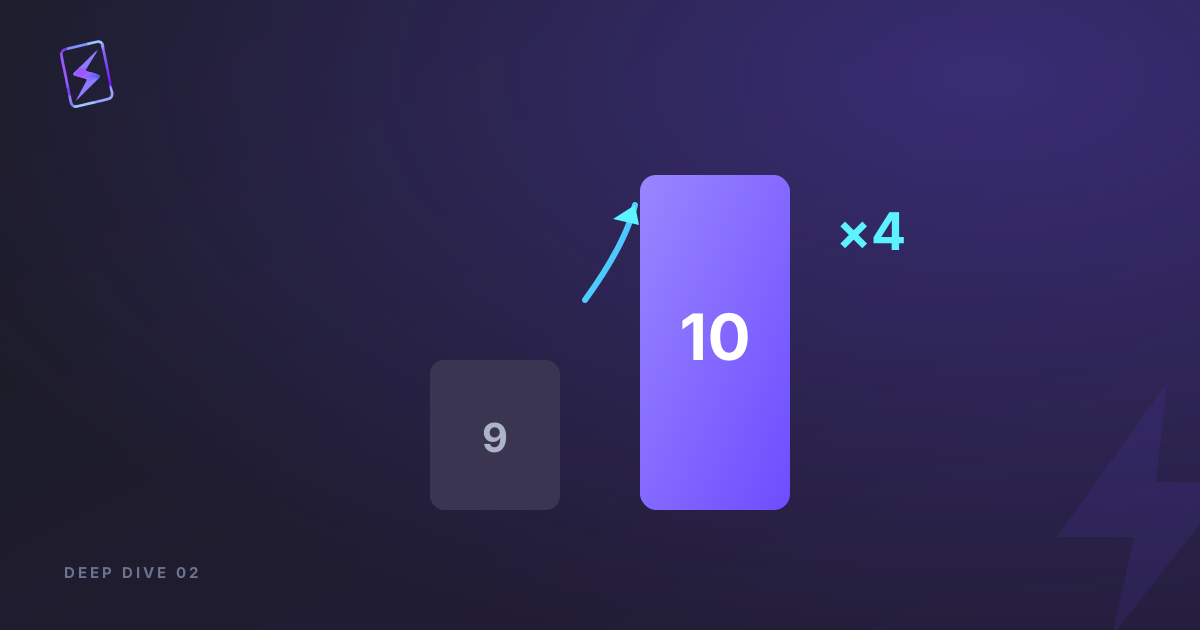
Here is the number that breaks people's intuition. Across our dataset, roughly 1,045,000 graded sold rows spanning 24,906 distinct cards, the gap between a PSA 9 and a PSA 10 is not a polite markup. On the 4,369 cards that had real sales at both grades, a PSA 10 sold for a median of 4.02× the PSA 9, with a mean of 5.21×.
Sit with that. A PSA 9 is a beautiful card. To the naked eye, across a room, you cannot tell it from a 10. The difference is often a microscopic whitening on one corner or a print line you need a loupe to find. The cosmetic delta is maybe two percent. The price delta is four hundred percent.
Markets do not pay multiples for marginal quality. They pay multiples for category changes. A 9 says "excellent, with a flaw." A 10 says "there is nothing to find." That jump, from "nearly perfect" to "the question is closed," is a discrete leap across a line, not a slide along a ramp. You are not paying 4× for slightly better corners. You are paying 4× to cross from one kind of object into another.
A raw card is an option. You just hadn't priced it that way.
This is the idea that should make the whole market click into place. A raw, ungraded card is, in the most literal financial sense, an option on a graded one. An option is the right (but not the obligation) to claim a future payoff, where the payoff only exists if a specific event happens. You hold a raw card. The event is: it comes back a 10. The payoff is the PSA 10 price.
Across 1,807 cards where we could pair raw sales against PSA 10 sales, the 10 commanded a median of 3.52× the raw (mean 6.75×). That spread is the option's potential payoff. But here is the entire game: you only collect it if the card gems. Send it in, get a 9, and the option expired worthless: you spent the grading fee to confirm your card is merely excellent.
So pricing a raw card is exactly an option-pricing problem. The value isn't the 10 price. It's the 10 price multiplied by the probability of actually getting a 10, minus the cost of finding out. Pay the full "it'll definitely gem" price for a raw card and you've bought a lottery ticket at the jackpot value. The house, meaning every seller of raws, would love you to keep doing that.
Expected value: the premium is a conditional, not a promise
Let's make the option concrete with the real cost of play. Grading runs roughly $15–25 per card, plus shipping both ways, plus weeks of waiting with your money locked up. That's the price of pulling the lever.
Now run the expected value, the probability-weighted average of every outcome. Say a raw card would fetch a PSA 10 price of $400, a PSA 9 price of $100 (recall that 4.02× median gap), and you judge it has a 50% shot at a 10. Half the time you win $400, half the time you win $100, so the graded card is worth on average $250 before costs; call it $225 after fees and shipping. If you can buy that raw for under ~$225, the math is on your side. Pay $300 hoping it gems, and you've overpaid for a coin flip.
The crucial word is conditional. The 4× premium is not something a card "has." It's something a card pays out, and only in the branch of the future where it grades a 10. Confusing the conditional payoff with the unconditional value is the single most expensive mistake in this hobby. The premium is real. It is also contingent, and the contingency is where amateurs donate money to professionals.
Why certified scarcity is worth more than actual scarcity
Grading does something subtle beyond resolving condition: it counts. Every slab is logged, so the population of, say, PSA 10s of a given card is a public, knowable number. This is the registry, and it converts a vague feeling of "this is rare" into a hard figure a buyer can underwrite.
Certified scarcity beats actual scarcity because it's provable. There might be a thousand pristine raw copies of a card sitting in binders, but no one can verify it, so no one will pay for it. Put 38 of them in PSA 10 slabs with a public population report, and now scarcity is a fact you can build a price on. The registry turns belief into evidence, and markets pay for evidence.
It also creates a competitive arena. Set registries reward collectors for assembling complete, high-grade runs, which manufactures demand at the very top grade specifically. The 10 isn't just nicer; it's the only grade that counts for the people racing to top a leaderboard. Scarcity plus a scoreboard is a powerful price engine, and grading builds both at once.
The flipper's edge lives in reading raws
If a raw card is an option, the edge belongs to whoever prices the underlying probability better than the market does. The grading companies aren't guessing; they're applying a rubric. So the entire flipper skill compresses to one question: can you predict the grade before you pay for it?
Learn the rubric, not the vibe. Centering, surface, corners, edges: these are measurable. A trader who can spot a 60/40 centering miss or a faint scratch under raking light is reading the option's payoff probability directly, while the seller priced it on a hopeful glance.
Hunt mispriced contingencies. The money isn't in cards that obviously will or obviously won't gem, which are fairly priced. It's in the genuinely ambiguous ones the crowd rounds down out of caution. If your read on the gem rate is even modestly sharper than the market's, that edge compounds across many cards.
Respect that the house knows too. Dealers who buy raws to grade are running this exact model professionally. The retail buyer paying near-PSA-10 money for a raw "that looks mint" is the counterparty funding everyone else's expected value. Don't be the exit liquidity.
The honest caveats: where the premium bites back
Every word above can be true and you can still lose money, because the premium has two ugly failure modes.
The premium evaporates on a 9. This bears repeating because it is the killer. You don't get a consolation prize proportional to your effort. You bought the lottery ticket, the lottery happened, and a 9 means you collected the small payout while paying the fee. The 4× spread that justified the whole bet only exists on the other side of the line.
Pop creep is relentless. Today's scarce 10 is tomorrow's common one as more copies get submitted and certified. The population report only goes up. A premium built on a low pop can compress quietly for years, and the registry that made the card valuable is the same machine slowly diluting it. Scarcity at the top grade is a moment, not a property.
And a structural note on whose certainty the market actually trusts: by 90-day sales volume, the distribution is lopsided, with PSA at 365,764, CGC at 82,824, BGS at 8,491. The premium isn't just for being graded; it's for being graded by the label the market has agreed to believe. None of this is advice. It's a way of seeing, and the math is yours to run.
The whole hobby, in one slab
The peak of all this is a single object: a 1st Edition Shadowless Base Set Charizard (4/102) that sold in PSA 10 for $325,700. That number isn't paying for ink and cardboard. It's paying for a card that crossed every line at once: the rarest print, in the rarest grade, with the population to prove it and a label the whole market trusts.
Strip the romance and it's pure economics. Information asymmetry, resolved. A conditional payoff that actually paid. Certified scarcity with a public count. An option that gemmed. Every force we've named, stacked on one piece of plastic.
The lesson scales all the way down to a $40 raw. You are never just buying a card. You are buying a probability, a resolved argument, and a number in a database, and the people who win at this are the ones who price all three before they hand over the money.
The takeaway: A PSA 10 premium isn't a markup for a nicer card. It's the payout on an option that gemmed, and a raw card is that option priced on the odds you can read better than the seller.
The numbers
- PSA 10 vs PSA 9: median 4.02×, mean 5.21× (4,369 cards with sales at both grades).
- PSA 10 vs raw: median 3.52×, mean 6.75× (1,807 raw↔10 pairs).
- Dataset: ~1,045,000 graded sold rows across 24,906 distinct cards.
- Grader share, 90-day sales: PSA 365,764 · CGC 82,824 · BGS 8,491.
- Typical grading cost: ~$15–25/card + shipping + weeks of wait.
- Top sale on record: $325,700, a 1st Edition Shadowless Base Set Charizard (4/102), PSA 10.
- Source & date: figures are computed from Surge Cards' comp pool, about 1,045,000 graded eBay sold comps (sourced via Scrydex), pulled in June 2026. The pool is recency-weighted: ~87% of these sales are from 2026 and ~95% fall within the past year, so it reads as a current-market snapshot rather than a multi-year history. Per-figure sample sizes are listed above; figures using a recent window (e.g. last 90 days) are labelled as such.
Price any card on the real data
Surge Cards is the ledger built for serious Pokémon flippers — live comps, projected profit, ROI, and fees on every buy and sell.
Get started freeFigures are drawn from Surge Cards' own dataset of graded sold listings (via Scrydex), skewed toward popular cards and recent sales. Directional, not financial advice. All amounts USD unless noted.